
After six months and eight failed bids, David Ellison’s Paramount Skydance has closed its acquisition of Warner Bros. Discovery for $110 billion at $31 a share, all cash. Outgoing CEO David Zaslav walks away with roughly $800 million in proceeds.
Ellison, 43, will run one of the largest entertainment conglomerates on the planet, starting from a position of $79 billion in debt and a leverage ratio of 6.6x EBITDA from day one.
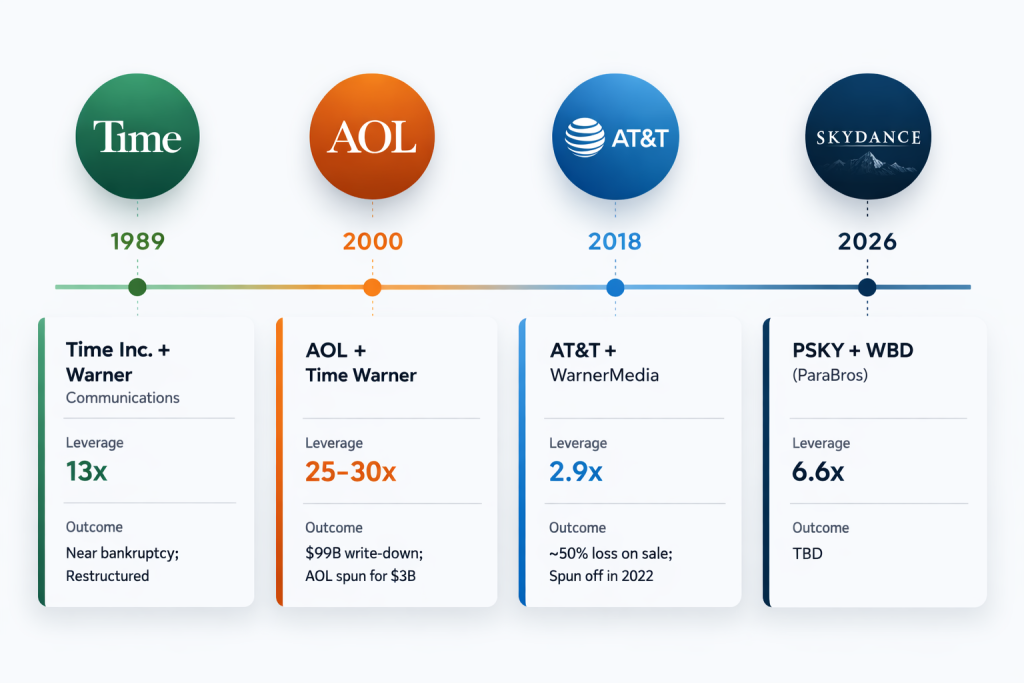
To understand what Ellison has taken on, it helps to look at who owned Warner Bros. before him.
Since 1967, the company has changed hands or undergone major structural re-organisation seven times. Each new owner arrived with what they thought was a compelling strategic thesis. Each one, within a few years, exited with considerably less capital than they brought in.
Debt, Camera, Action
Time Warner’s 1989 merger loaded the business with $10.8 billion in debt and nearly broke it within a decade. AOL’s $167 billion takeover in 2000, built on inflated dot-com valuations and advertising figures that later proved fraudulent, ended in a $99 billion write-down. AT&T paid $85 billion for WarnerMedia in 2018 and sold it four years later for $43 billion. The subsequent merger with Discovery created WBD with a 5x leverage ratio and a structural tension between its unscripted cable roots and its premium drama assets that management never fully resolved.
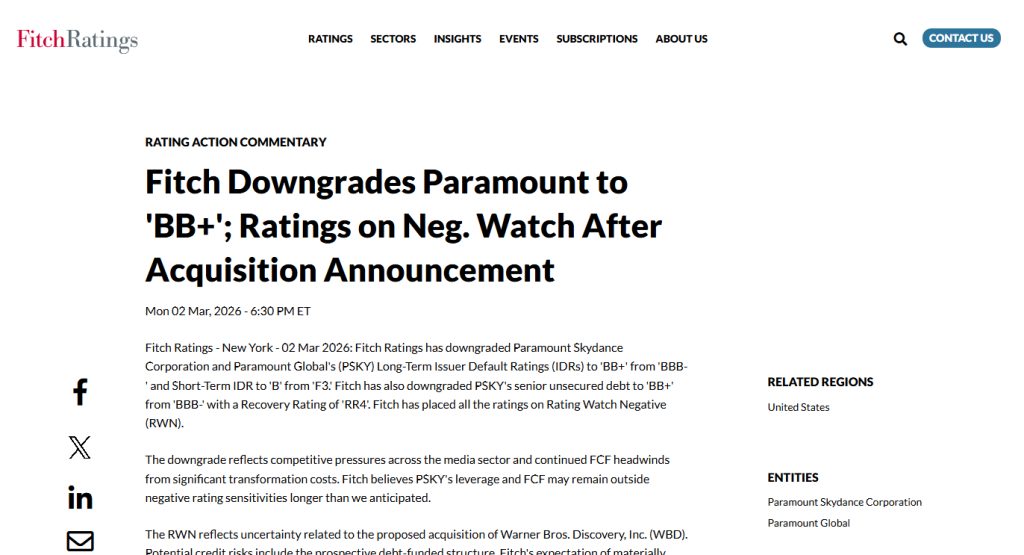
Now comes the combined Paramount Skydance and Warner entity, carrying a 6.6x leverage ratio, $54 billion in newly arranged debt from Apollo, Bank of America, and Citigroup, and a public commitment to $6 billion in “synergies” (code for layoffs) within three years. On the investor call after signing, Ellison told analysts: “This is not about consolidation. It’s about reinventing the business.” Fitch promptly downgraded PSKY’s debt to junk. S&P placed all PSKY debt on credit watch with negative implications.
Netflix’s step forward
Netflix and its CEO Ted Sarandos spent months positioning themselves as the more credible acquirer, one whose ownership would preserve HBO’s standing and avoid the kind of debt-driven restructuring that had damaged the brand under previous owners.
But mounting regulatory pressure changed the calculus. The Justice Department opened an antitrust investigation. Political pressure from the White House targeted Netflix’s board composition. A Senate hearing surfaced bipartisan opposition to combining the top two streaming services into a single entity with over 450 million subscribers. Netflix ultimately declined to match or beat PSKY’s final offer.
What looked like a retreat turned out to be a sound financial outcome. Netflix shares rose 14% after the withdrawal (around $60bn of equity value gained). The company collected a $2.8 billion breakup fee (approx. 15% of its annual content budget).
A separate theory gained traction on Wall Street: that Netflix’s involvement was less about acquiring WBD and more about keeping Paramount Skydance out of it for as long as possible, buying Zaslav time to complete his planned spinoff of the Global Networks business. A WBD without that division’s cash generation would have been a less attractive target for PSKY who needed the earnings to service its mounting debt. Whether intentional or not, the effect was that PSKY paid well above its opening position and inherited obligations it will now need to justify to its lenders.
The numbers Ellison must hit
On its investor call, the combined company projected $69 billion in revenue and $18 billion in EBITDA for 2026, including $6 billion of synergies. Getting leverage down to a more sustainable 4x ratio would require closer to $16 billion in cost savings, not $6 billion. The gap between those two figures is the central financial risk of the deal.
The combined entity has already cut 2,000 jobs at Paramount. Integrating CBS News and CNN, consolidating HBO Max and Paramount+ into a single streaming product, and rationalising two large real estate portfolios will occupy management for the next two years at minimum. Ellison has also been public about pursuing AI-driven production efficiencies at scale. Whether that technology can contribute meaningfully to debt reduction while the business also tries to grow its subscriber base against a financially stronger Netflix is a question the market has not yet answered.
The one unambiguous winner
David Zaslav took over WBD in 2022 with $55 billion in inherited debt and an instruction to make it work. He cut costs aggressively, restructured the balance sheet, and then ran a sale process that attracted two serious competing bidders and drove the final price to nearly five times the stock’s pre-process trading range. He leaves with approximately $800 million. His successor takes on the leverage ratio.
Warner Bros. has been through this cycle before. The studio’s underlying intellectual property is genuine and valuable. The debt attached to it is also genuine and substantial. History suggest debt wins; will this episode be any different?
From the desk of IGB
Source post: Blackbull Research - Substack